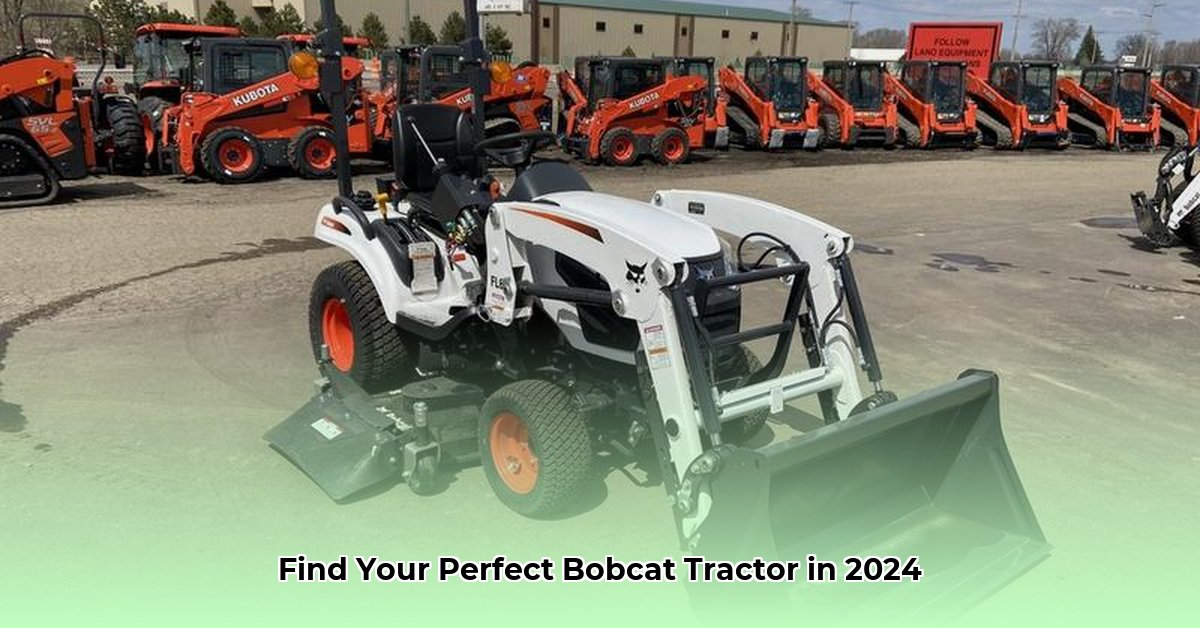
Choosing the right subcompact tractor can be daunting. This guide helps you navigate the Bobcat lineup, comparing models, highlighting key features, and offering actionable advice to find the perfect fit for your needs and budget. For more in-depth analysis, check out this helpful resource: Bobcat tractor reviews.
Understanding Bobcat Subcompact Tractor Series
Bobcat offers several subcompact tractor series, each designed for varying tasks and property sizes. Key differences lie in horsepower, lift capacity, transmission type, and available features.
1000 Series: Ideal for smaller properties and light tasks like landscaping and gardening. These tractors are easy to maneuver in tight spaces. Think of them as the versatile "handymen" of the Bobcat family.
2000 Series: Offers increased power and capability compared to the 1000 Series. Suitable for larger properties and more demanding tasks such as mowing larger lawns or tilling gardens.
3000 Series: Detailed specifications for the 3000 Series are still emerging. Contact your local Bobcat dealer for the most up-to-date information and model-specific details.
4000 Series: Built for serious work on larger properties or smaller farms. These tractors offer significantly increased horsepower and lift capacity, making them suitable for heavy-duty tasks.
5000 Series: These are the heavy hitters, designed for demanding agricultural work and large-scale projects. Expect maximum power and durability.
Key Features to Consider
Several key features differentiate Bobcat subcompact tractors. Understanding these will help you narrow your choices:
Horsepower: This dictates the tractor's power and capability. Higher horsepower means more power for heavier attachments and larger properties.
Lift Capacity: The maximum weight the tractor's lift system can handle. Ensure it's sufficient for your intended attachments.
Transmission: Hydrostatic transmissions provide smooth, easy operation and precise speed control, ideal for delicate tasks. Manual transmissions offer more control, particularly beneficial for engine-powered attachments. Choosing between these depends on your experience and intended use.
Cab Options: Open-station models offer better visibility and are generally less expensive, while enclosed cabs provide weather protection and greater comfort.
Three-Point Hitch Category: This defines the size and type of compatible attachments. Category 1 is common for subcompacts; larger tractors may use Category 2 hitches.
Comparing Bobcat Subcompact Tractor Series
The table below provides a general comparison. Always consult the manufacturer's specifications for precise details on individual models.
| Feature | 1000 Series | 2000 Series | 3000 Series | 4000 Series | 5000 Series |
|---|---|---|---|---|---|
| Horsepower | Low | Medium | To Be Determined | High | Very High |
| Lift Capacity | Low | Medium | To Be Determined | High | Very High |
| Transmission | Hydrostatic | Hydrostatic/Manual | To Be Determined | Hydrostatic/Manual | Hydrostatic/Manual |
| Cab Options | Open/Enclosed | Open/Enclosed | To Be Determined | Open/Enclosed | Open/Enclosed |
| 3-Point Hitch | Category 1 | Category 1 | To Be Determined | Category 1/2 | Category 2 |
Attachments: Expanding Capabilities
Bobcat offers a wide range of attachments to enhance your tractor's versatility. Mowers, tillers, loaders, and backhoes are just a few examples. Before purchasing, determine which attachments you'll need and verify their compatibility with your chosen model.
Making the Right Choice: Your Bobcat Journey
Selecting a Bobcat subcompact tractor requires careful consideration of your budget, property size, intended use, and long-term maintenance costs. Test driving several models is highly recommended. Your local Bobcat dealer is a valuable resource for information and advice. Take your time, research thoroughly, and choose the tractor that best suits your individual needs.
Comparing the Bobcat 3000 Series to Other Brands
The Bobcat 3000 series, while still under development, will soon require thorough comparison to competitive models. This process requires a systematic approach:
Define Your Needs: First, identify your top priorities. Heavy-duty tasks? Fuel efficiency? Specific attachment needs?
Gather Specifications: Obtain detailed spec sheets for all tractors under consideration. Compare horsepower, lift capacity, transmission type, three-point hitch category, ground clearance, and fuel efficiency.
Create a Comparison Table: Organize data in a clear table for easy visual comparison of key features across models.
Analyze the Data: Note strengths and weaknesses of each model. Consider trade-offs between power and fuel efficiency, or price and features.
Research User Reviews: Supplement your analysis with unbiased user reviews to gain insights into real-world performance.
Check Attachment Compatibility: Ensure that the attachments you need are compatible with each tractor model.
By following these steps, you can make a well-informed decision and choose the best subcompact tractor for your needs. Remember, the most effective tractor is the one best suited to your specific tasks and budget.